

Gödel, cognitive overload, and the moon
A reflection on the comfort of the unknown

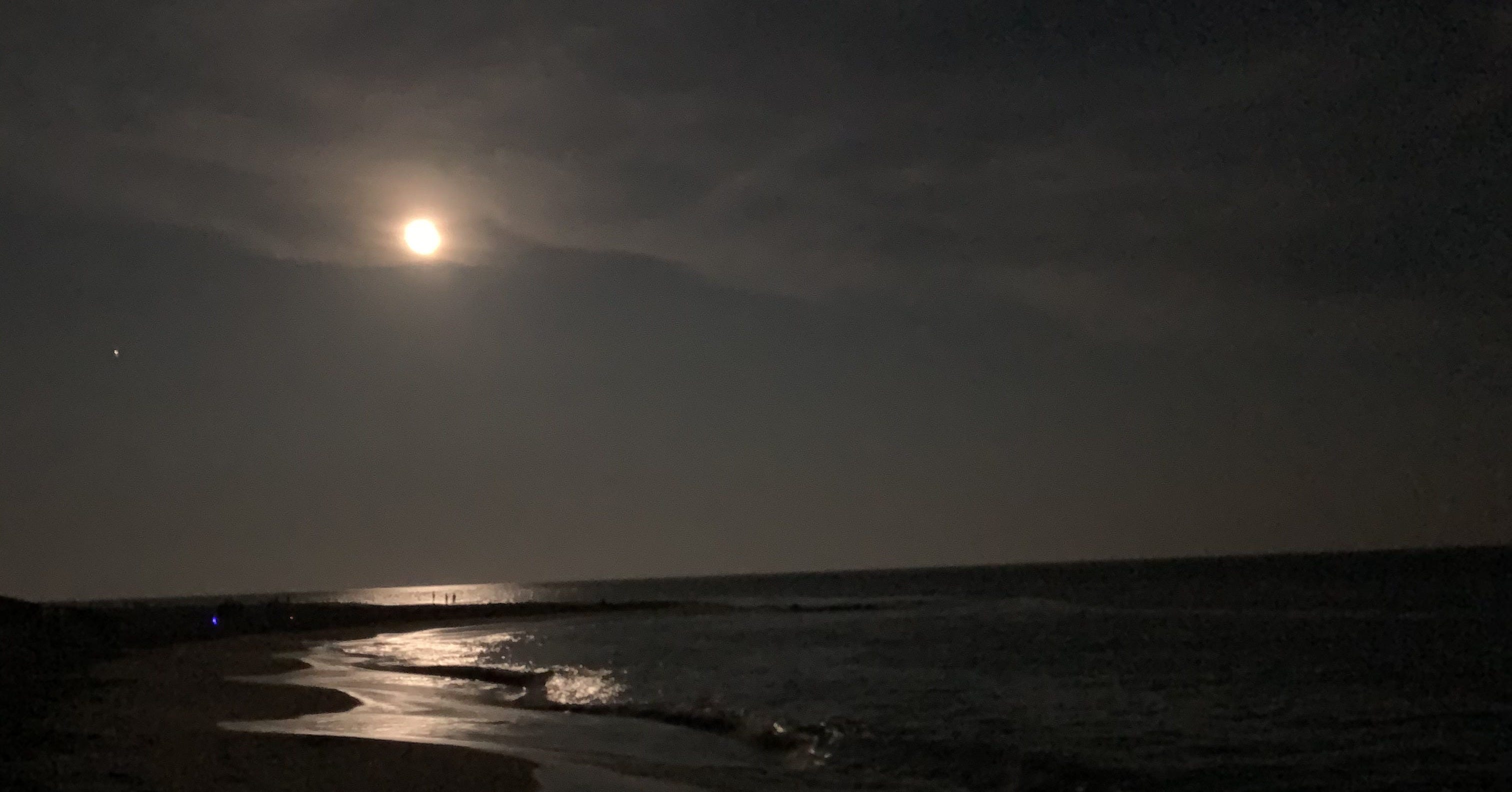
Over the past few years I’ve allowed myself to fall in love with the moon.
There’s a beauty to her I struggle to fully comprehend, but I’ll put forth the idea that it is both elegant and wise. She’s known this earth longer than me or my ancestors or who came before them. The moon has seen things, wonderful and tragic, and carries those stories with her through the millennia as she shares her own: waxing and waning, learning and growing, living and breathing.
I find comfort with the moon, a connection, a sense of familiarity. When I find myself at a crossroads I look to her phases and ask what they invite me to do; where they invite me to go. I couldn’t explain to you how it logically all works, and maybe I don’t want to. Her mystery grounds me in a way I don’t think order ever will.
The idea of spirituality and something “greater” is a complicated subject for me, as it often is for most people. Despite technically being raised Catholic I don’t identify with the religion. The concept of organized faith in general never resonated with me, so that also rules out any chance of formal conversion.
However I don’t feel as if I have the authority to say there is absolutely nothing out there. Sometimes I feel as if the idea of not knowing is seen as a sign of weakness or failure. While I partly credit this to natural human evolutionary instincts — “I won’t go in that dark cave because there possibly may be a big bear hiding in the shadows,” — I also worry our current digital age has created an expectation for quick-look-up solutions.
And if there is no easy conclusion? Some people would rather deny a possibility all together, even without disproof, than dip into the discomfort of existing alongside the unknown.
Comfort. That’s a key word here. When most answers are a Google search away it can feel uncomfortable when a query cannot be solved in a few moments. Further, when scientific research is unable to explain larger-scale questions, we often are forced to confront the possibility of forces beyond our control and understanding. This is an instinctually (possible big bear) and socially (“am I stupid?”) nerve-racking reality to digest.
But it is physically impossible to know everything. For as much freedom as they give us, our bodies pose limits. A topical example is information fatigue syndrome: a physical burden the brain can experience due to an overexposure of online media, otherwise known as “cognitive overload.” We literally were not built to know it all, and when we try it can lead to disruptive physical and mental effects.
Maybe we were never supposed to know everything in the first place.
During a recent late night internet deep dive I came across Kurt Gödel's incompleteness theorems. Feel free to look into the intricacies, but for simplicity’s sake all you need to know is this: Gödel discovered two paradoxes that revealed systems like mathematics will always have unprovable truths and inconsistencies. Essentially, even a field as logical as math relies on elements of the unknown.
While some initially believed these theorems would completely destroy the work of mathematicians around the world, the discoveries actually provided researchers with the freedom to explore new possibilities in their studies. Gödel’s work even provided crucial foundations for early computer science.
It was the acceptance of the unknown that allowed mathematics to advance. If the field decided to ignore these ideas simply because they didn’t make logical sense, it would have stalled and prevented generation defining developments. With this in mind, I feel pretty comfortable with the idea that I can never know for sure how the universe works.
Maybe I should’ve started with the short version and said I’m a spiritual agnostic: while I believe there is no way to prove or disprove ideas concerning religion / metaphysics / otherworldly concepts, I personally believe there to be something more than the physical world as we know it.
Why? As much as we need to navigate with our brain, I also feel we need to listen to our gut. While I can’t share concrete proof of my experiences, feelings, and intuition with others, I can honestly say they all lead me to believe I’m never really alone.
I feel a protective presence when the sun emerges from the clouds and hits my face with a warm ray of light. As wind billows against my window I hear the house creak as if to say “don’t worry, I’ve got you.” I’ll hold gifts from loved ones — alive and passed — and still feel subtle scents of their energy around me, as if they were standing right behind.
For some people, that’s not enough. And that’s okay. I’m not here to try and enforce my beliefs on anyone. As long as you are a decent human with good intentions, I really don’t mind what you believe (or don’t).
All I hope to do is provide more insight into who I am, how I think, how I feel, and maybe spark some dialogue. Maybe that’s the most comforting thing in this world: sharing ideas and finding connection in others because of it.